Sources in Iraq reveal unprecedented details about a large-scale operation by foreign forces, apparently Israelis, in the deserts of Najaf and Al-Anbar. From night landings, through the establishment of fortified outposts, to the bombing of Iraqi border guard forces and the arrests of local citizens. All the details, names, and coordinates behind the incident that could reignite the Middle East. This involves a logistics center and base for Israeli search and rescue teams, established right before the outbreak of the war and with the knowledge of the United States, in support of airstrikes in Iran using aircraft and UAVs.

In the dead of night, the absolute silence of the Iraqi Najaf desert was broken by the roar of heavy rotors. What began as vague reports on local Iraqi networks is becoming clearer as one of the most secretive and daring operations seen on Iraqi soil in recent years.
Testimonies from the field, accompanied by exact locations and names of those involved, indicate that this was not a localized infiltration, but a complex operation by foreign forces, with officials in Baghdad pointing the finger at American and Israeli forces. The assessed goal: creating a logistical bridgehead to support strikes in Iran using aircraft and UAVs, while simultaneously housing Israeli Air Force special forces trained to conduct commando operations in enemy territory, so they could respond quickly to combat search and rescue (CSAR) missions.
Firestrike in the Najaf Desert
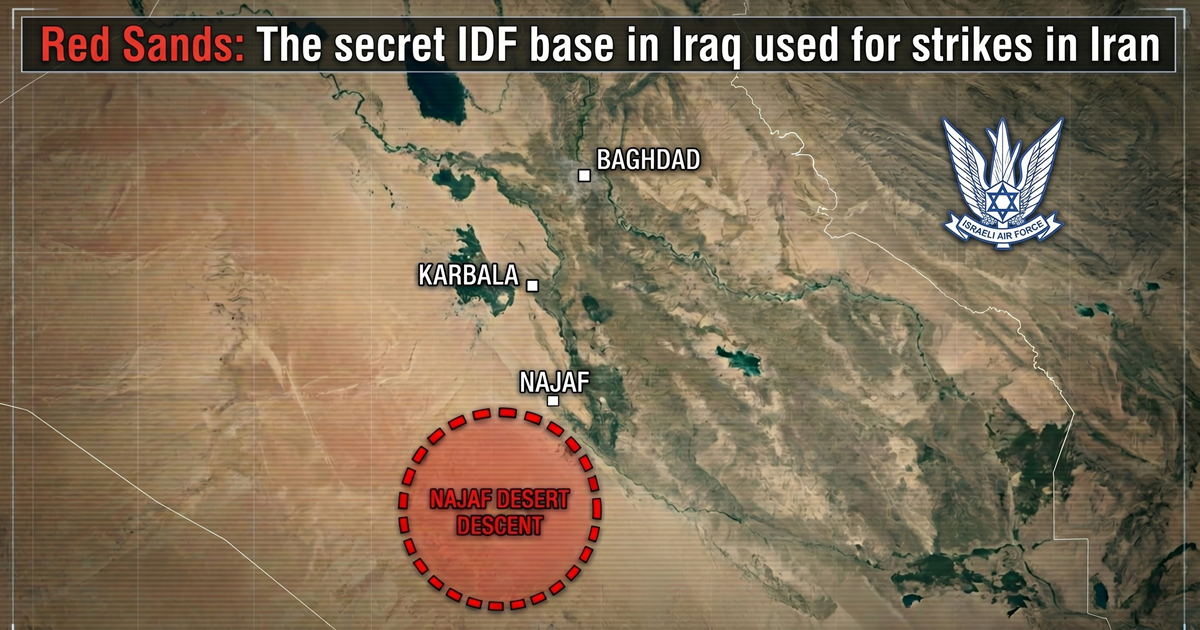
The main event occurred when a force of between four to seven helicopters executed a troop landing in the Najaf area. According to information coming from the field, the operation was documented west of Najaf near the border with Saudi Arabia in the heart of the Najaf desert, just about 40 kilometers southeast of the city of Najaf itself:

Map of the landing zone according to Iraqi sources
The activity did not escape the notice of local forces, and the encounter almost exposed the base at an early stage of the confrontation in early March, after a local shepherd noticed unusual military activity that included helicopter flights and reported it. An Iraqi patrol convoy sent to investigate the unusual movement in the area, which set out at dawn in Hummer vehicles, met a lethal response. The foreign force, in an attempt to protect the covert activity or the surveillance equipment that had been deployed, and as confirmed by official sources in the US, was an IDF force that carried out the operation. To drive the soldiers away, direct airstrikes were directed at the Iraqi patrol. The result was severe: one Iraqi soldier was killed and two others were injured.
Lieutenant General Qais al-Muhammadawi, Deputy Commander of the Joint Operations Command in Iraq, addressed the strike on state media and said: “This reckless action was carried out without coordination or approval”. Following the incident, the Iraqi government condemned the operation and filed a complaint with the UN, claiming the attacks were carried out by foreign forces and attributing them to the US. However, American officials clarified to the newspaper that the US was not involved in this strike at all.
Footage purportedly shows US military transport aircrafts making a landing in Iraq’s Najaf deserts pic.twitter.com/JTqLUJBs9e
— Rudaw English (@RudawEnglish) March 5, 2026
Video of military transport aircraft landing in the Najaf desert in Iraq in early March
The Secret Outpost in Al-Anbar: Armored Vehicles and Tents
But it turns out that Najaf was just one arena among several. A few hundred kilometers away, in the Al-Anbar desert, an equally disturbing picture was revealed. South of the Al-Nukhaib district, in an area known as Shanan and close to the Al-Adyan area, residents and local forces identified extensive ground activity. In the heart of the Al-Anbar desert, deep in the territory, southwest of the town of Al-Nukhaib near the border with Saudi Arabia:

Map of the second landing zone according to Iraqi sources
According to testimonies, six helicopters unloaded troops and equipment in the area, and immediately afterward began the establishment of a military camp clearly identified as tents. At the same time, armored military vehicles of the Hummer type were deployed in the area, apparently intended to secure the new facility and control the desert traffic routes frequently used for weapons smuggling. The searches for the foreign forces in the area did not end with the first encounter. The authorities in Iraq dispatched two additional units from the country’s counter-terrorism forces, a significant body in its fight against ISIS, to the area. The forces discovered tangible evidence of military forces that had been at the site. “It seems there was a certain force on the ground before the strike, which received air support, and operated beyond the capabilities of our units,” al-Muhammadawi admitted.
A 300-Kilometer Front: A Massive Operation Dominating Western and Southern Iraq
A geographical analysis of the published locations reveals another dramatic detail, indicating that this is not a localized operation but an operation of massive proportions. While one point is located deep in the Al-Anbar desert, near the border with Saudi Arabia, the second point is located just about 40 kilometers from the city of Najaf. The aerial distance between these two locations is about 300 kilometers. This fact indicates that the foreign forces operated simultaneously across a vast front stretching over hundreds of kilometers of desert terrain, apparently with the intention of creating a continuum of strategic outposts commanding the movement space in western and southern Iraq.
Entered from Syria with Air Cover: Testimonies in the Iraqi Parliament
The official silence in Baghdad was broken when Iraqi members of parliament rushed to reveal additional details shedding light on the incident. A member of parliament from the Karbala governorate, Zuhair al-Fatlawi, made a dramatic statement and claimed that it was “a force considered American that carried out a rapid landing operation in the desert with air cover”. According to him, the foreign force “entered from the direction of Syria” and included between four to seven helicopters accompanied by the deployment of Hummer vehicles. Another member of parliament, Mohammed Jassim al-Khafaji, confirmed the scale of the confrontation when he wrote that “a military force from the Iraqi army… consisting of about 30 Hummer vehicles and flying Iraqi flags, went to patrol and clarify the situation regarding the landing, but was subjected to aerial bombardment”.
🔴Iraqi reports: Iraqi army sends elite counter-terrorism units to the Najaf desert following clashes between the Iraqi army and American forces🔴
— Or Fialkov (@orfialkov) March 5, 2026
According to Iraqi reports yesterday, there were clashes between American forces and the Iraqi army that resulted in the death of a security officer and the injury of two others in the Najaf desert pic.twitter.com/udT23FMCrX
Video of the Iraqi army sending elite counter-terrorism units to the Najaf desert
The Human Cost: Detainees and Casualties
The violation of Iraqi sovereignty does not merely end with the establishment of outposts, but also with direct harm to security personnel and citizens who were at the wrong time and the wrong place: The prominent names that emerged from the incident are Zaidan Sha’alan and Arash al-Majri, born in 2001. Young men serving as soldiers in the Iraqi border guard, belonging to the Fifth Division. The attack on official security personnel, like Zaidan and his comrades, puts the Iraqi government in enormous embarrassment vis-a-vis its citizens, as it struggles to explain how a foreign force attacks its soldiers on its soil without a response.
To maintain the veil of secrecy surrounding the operation, the foreign forces acted aggressively against civilian presence. A notable incident occurred when Sayyid Amir Mael-Abbas, a resident of the Najaf governorate, was arrested by the forces in the field and detained for interrogation and isolation for three hours, apparently to prevent him from calling for backup or documenting the covert activity. The escalation in the field did not spare the senior ranks of the Iraqi army. According to government sources, during the bombing by foreign aircraft on a patrol force of the 41st Brigade, a senior infantry officer, Colonel Haider Abd al-Sada Radi al-Khazaali, commander of the second battalion, was severely injured. Along with him, three other soldiers from the brigade’s personnel were injured. The wounded were evacuated under fire and transferred for urgent medical treatment at the Karbala hospital, where they are currently hospitalized.
🔴Iraqi sources: Low-altitude flights of CH-53 transport helicopters between Karbala and Najaf in Iraq🔴
— Or Fialkov (@orfialkov) March 15, 2026
According to the Iraqis, Israel and the United States use these helicopters pic.twitter.com/9MAPfoOuCX
Low-altitude flights of CH-53 transport helicopters between Karbala and Najaf in Iraq documented in mid-March
Deafening Silence and the Testimony of the Israeli Air Force Commander
The authorities in Baghdad announced the opening of an immediate investigation into the events, but in practice, it seems there is intentional radio silence. The United States and Israel refuse to comment on the reports. Similarly, the Iraqi government spokesperson refused to comment officially on the incident and declined to answer the question of whether the government knew in advance about the existence of the Israeli base. But the information revealed connects to a dramatic announcement by the Commander of the Israeli Air Force, Maj. Gen. Tomer Bar, published recently, which stated: “The fighters of the special units of the Air Force are currently carrying out extraordinary missions that could ignite the imagination”.

Letter from the Commander of the Air Force
The quote, cited from an internal message dealing with the large-scale strike “into the heart of Iran”, provides a glimpse into the escalation of commando activity, and possibly explains a significant part of the question of who is behind the helicopter invasion. Between the deployment of advanced surveillance equipment to nighttime airborne operations, the western and southern deserts are turning into a military no-man’s-land. Has the government in Baghdad lost control, or is it a silent partner?
The Crushing Proof: Satellite Images Reveal the Runway in the Heart of the Desert
Satellite image analysis conducted by @obretix, reveals the logistical infrastructure that the IDF established in the Iraqi desert: a temporary takeoff and landing runway about 1.6 kilometers long that was prepared on the ground of a dry lake. The photos from March 16 document the site at the peak of its operational activity, corroborating the reports regarding the existence of a forward outpost and logistics center for special forces and rescue teams. The satellite documentation provides physical proof of the planned construction of the outpost and explains how the prolonged aerial campaign against Iran was made possible, by creating an aviation bridgehead in the heart of enemy territory, which allowed for rapid rescue and logistical support in real-time. The accidental discovery of the site by the Iraqi shepherd and the ensuing battle, as revealed, correspond exactly with the satellite documentation of an active and bustling site in the heart of the arid terrain.


Satellite documentation of the temporary landing strip (1.6 km) in the heart of the Iraqi desert. The quickly prepared runway route is noticeable, the satellite photos from March 6, 8, and 16 show the runway and logistical structures already built
Detour via New York: The Truth About the Secret Base in Iraq and the Paradox of Israeli Censorship


The follow-up in Al Jazeera and the publication in the Wall Street Journal
About the Author
Or Fialkov is an independent researcher and a respected expert in the fields of Open Source Intelligence (OSINT), military history, terrorism, and artificial intelligence technologies. With a rich background in analyzing combat campaigns, he combines events of the past with the digital tools of the future.