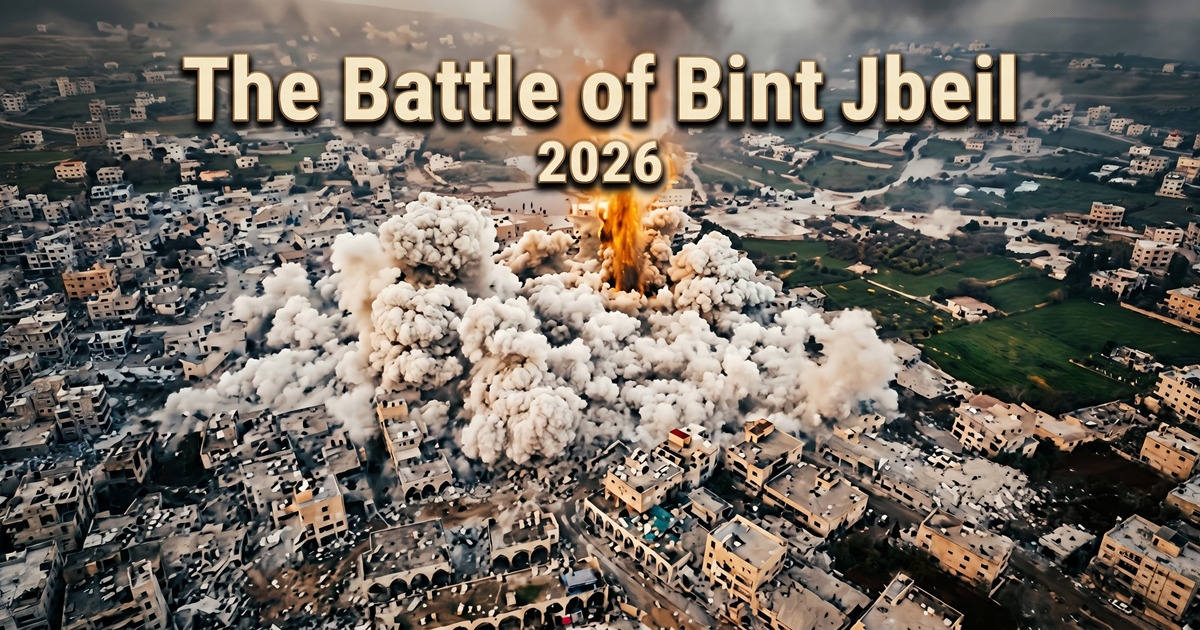
The campaign to conquer the town of Bint Jbeil in southern Lebanon, which began on April 9, 2026, constitutes one of the decisive points in the 2026 Lebanon War, and in the Israeli-Lebanese conflict as a whole. This research presents a comprehensive in-depth analysis of the current battle, while placing it on an historiographical and operative timeline that includes the 2024 maneuver and the war of attrition of 2025. From the analysis of data emerging from the field, it appears that unlike past campaigns (and particularly the Second Lebanon War in 2006 and the limited maneuver in 2024), the IDF is currently implementing a doctrine of spatial destruction and de facto conquest, as part of Operation Silver Plow.
Bint Jbeil, known by Hezbollah as the capital of the resistance and by Israel as the capital of terror, carries immense symbolic significance due to the town’s stadium, where Hassan Nasrallah delivered the famous Spider Web speech in 2000. The destruction of the stadium and its demolition by the forces of the 98th Division symbolize a deep cognitive break for Hezbollah. Strategically, the town commands central intersections and constitutes the connecting link in the anti-tank missile line, an 8-kilometer deep security buffer that Israel is acting to establish in order to deny direct fire capabilities toward the settlements of the Galilee.
The research below will review the sequence of events from 2024, through the escalation of early 2026, up to a day-by-day tactical analysis of the urban warfare (CQB) in Bint Jbeil in April 2026, while deducing regional geopolitical implications, including the impact of the negotiations taking place in Washington and the consequences of the ceasefire with Iran.
The research is based on information from open sources, IDF spokesperson reports, satellite imagery, and information from the Lebanese, any error is mine and I would be happy to receive feedback.
Introduction and Historical-Strategic Context
Bint Jbeil is located in southern Lebanon, a few kilometers from the Israeli border, and serves as a central urban hub in a largely rural and mountainous area. Its topographical location grants whoever controls it an advantage in observation and fire over vast areas in southern Lebanon, as well as control over the Tibnin-Bint Jbeil axis, which forms a critical logistical artery connecting the south of the country to the Litani River.
Beyond its tactical importance, the town is loaded with tremendous psychological significance for both warring sides. Following the IDF’s withdrawal from the security zone in May 2000, then-Hezbollah Secretary General Hassan Nasrallah chose the municipal stadium of Bint Jbeil as the venue to deliver his victory speech. In this speech, which is deeply burned into both the Israeli and Arab consciousness, Nasrallah coined the term Spider Web to describe Israeli society, arguing that despite its military might, it lacks internal resilience and is destined to crumble under the pressure of the resistance. In the east of the town is the Triangle of Liberation, an intersection and strategic area that constitutes a critical meeting point connecting the town of Bint Jbeil to the villages dominating it, primarily Maroun al-Ras, and serves as a central access route towards Aitaroun and Aita al-Shaab. The triangle is located in close proximity to significant public buildings that allow for cover and entrenchment, such as the vocational school of Bint Jbeil and the al-Saraya school. The name “Triangle of Liberation” was coined by Hezbollah as part of the organization’s historical narrative, referring to the IDF’s withdrawal from southern Lebanon in May 2000 (an event celebrated in Lebanon today as Resistance and Liberation Day). The place became a symbol of steadfastness also during the Second Lebanon War in 2006, serving as a tactical defense line for the organization.
🔴Where is the terrorist and where is the spider web? The stadium in Bint Jbeil will burn tonight🔴
— Or Fialkov (@orfialkov) April 11, 2026
The fall of Bint Jbeil is the fall of Hezbollah pic.twitter.com/JoWO18nYBB
In the Second Lebanon War (2006), the IDF attempted to conquer the town in order to erase the disgrace of the speech and strike the organization’s center of gravity. However, that battle was seared as a difficult event, fraught with casualties for IDF forces (especially for the Golani Brigade and the Paratroopers Brigade, which lost eight fighters in battle), and the town was not fully conquered. In the first battle, the Golani Brigade force (Egoz Unit, Battalion 51, and the Golani Reconnaissance Battalion) advanced from the east to the town from the direction of Aitaroun and seized several buildings in the east of the town with the aim of setting ambushes inside buildings (straw element), after Golani advanced towards the center of the town they encountered Hezbollah terrorists. After a battle that lasted 11 hours, the wounded were rescued, and 8 fighters and commanders were killed in the battle. Two days later, a second battle took place in which the IDF deployed 4 brigades: Golani, Paratroopers, the 7th Armored Brigade, and the 401st “Iron Tracks” Armored Brigade, as well as an artillery regiment. The plan was for Golani to advance from the east while the Paratroopers advanced from the west, and the armored brigades would remain on the ridges overlooking the town in Maroun al-Ras and Yaroun. The 401st Armored Brigade was supposed to break through to the Shal’aboun ridge west of the town to direct fire onto the town from the west. Despite artillery shelling and bombings, and seizing the Saf al-Hawa intersection in the northwest of the town, the exposure of the force by Hezbollah terrorists led to a battle that lasted 9 hours in which a large number of soldiers were injured and the IDF withdrew under fire from the town. This failure contributed to cementing the town’s status as a symbol of Hezbollah’s steadfast resistance (Sumud). In light of this history, the 2026 campaign is not just a military effort to clear a launching area, but a strategic move intended to close a historical loop and shatter the myth of the resistance from its core.
The 2024 Campaign - The First Maneuver and its Consequences
After almost a year of a war of attrition on the northern border (which began in October 2023 parallel to the war in the Gaza Strip), Israel changed the deterrence equation. In September 2024, Hezbollah suffered an unprecedented blow during the Pager Operation, in which thousands of communication devices exploded across Lebanon, leading to a critical blow to the organization’s operational command and control spine. Immediately thereafter, on September 23, the Israeli Air Force launched a series of high-intensity strikes that claimed the lives of over 800 people and injured about 5,000. The peak of the aerial campaign occurred on September 27, 2024, when Hassan Nasrallah was eliminated, along with Ali Karaki (commander of Hezbollah’s Southern Front) and other senior figures, in a subterranean strike in the Dahiyeh neighborhood of Beirut.
Following the aerial softening, on October 1, 2024, an Israeli ground maneuver began (Operation Northern Arrows). The goal of the 2024 invasion was not a deep conquest of Lebanon, but rather striking Radwan Force infrastructure (tunnels, bunkers, and weapon stockpiles) in villages adjacent to the border, such as Ayta ash Shab, Meiss el Jabal, and Kfar Kila, understanding that Hezbollah had planned a large-scale invasion into Israeli territory similar to the events of October 7. The 2024 campaign officially ended on November 26 with the signing of a ceasefire agreement brokered by France and the US, which went into effect on November 27.
During the ground maneuver of Fall 2024, the IDF focused primarily on clearing the first line of border-adjacent villages in the Bint Jbeil district, such as Aitaroun, Maroun al-Ras, and Yaroun. However, the IDF refrained from taking over Aitaroun and the town of Bint Jbeil itself, leaving pockets of resistance in the area, and focused on bombing the town from the air in a series of strikes.
🔴Bint Jbeil after the IDF crushed it from the air🔴
— Or Fialkov (@orfialkov) October 4, 2024
The town is almost completely empty, destruction everywhere pic.twitter.com/SzzamCcqoi
🔴Bint Jbeil has become a ghost town🔴
— Or Fialkov (@orfialkov) October 5, 2024
Bint Jbeil area of Saf al-Hawa square. Extensive damage to houses, shops, and a mosque. Major damage to Salah Ghandour Hospital
Hezbollah's main terror headquarters is on its way to being wiped off the map pic.twitter.com/YQ3IvFHfGv
Map of the Bint Jbeil area at the end of the 2024 ground maneuver
Map credit: Stinky

Since the outbreak of the Swords of Iron War, the IDF carried out a long series of targeted assassinations of Bint Jbeil commanders. On November 22, 2023, Abbas Muhammad Raad, commander of the Bint Jbeil sector, was eliminated. A few months later, on February 23, 2024, Muhammad Abd al-Rasul Alawiyah, commander of the Maroun al-Ras area, was eliminated. On October 7, 2024, Ahmad Hassan Nazal, responsible for the Bint Jbeil area in the Radwan Force, and Ali Ahmad Ismail, responsible for artillery in Bint Jbeil, were eliminated. On October 17, 2024, Hussein Muhammad Awada, a battalion commander in the Bint Jbeil area, was eliminated, and the next day, on October 18, 2024, Nasser Abd al-Aziz Rashid, deputy commander of the Bint Jbeil sector, was eliminated. On October 25, 2024, Ahmad Jaafar Maatouk, commander of the Bint Jbeil sector, who replaced Abbas Muhammad Raad who was eliminated almost a year earlier, was eliminated.
The Year 2025 - Erosion of the Status Quo and the Campaign Between the Wars
The November 2024 ceasefire agreement was intended to ensure the distancing of Hezbollah north of the Litani River, but in practice, 2025 turned into an arena of constant friction reminiscent of an accelerated Campaign Between the Wars (CBW). Hezbollah began violating the terms of the agreement systematically in an effort to rehabilitate its infrastructure and weapons arsenal in the areas from which it withdrew, while Israel attempted to enforce the agreement through proactive preventive aerial actions. Throughout 2025, the IDF acted dozens of times to prevent the establishment of anti-tank cells and rocket launchers in the Bint Jbeil district.
During 2025, no ground maneuver took place. The IDF’s presence in the Bint Jbeil area this year was characterized mainly by a remote war of attrition that included aerial strikes, artillery fire, and targeted assassinations using UAVs. Except for a tactical point positioning of military vehicles on the outskirts of border-adjacent villages like Aitaroun for security purposes, IDF ground forces did not enter deep into the district and did not operate on the ground in Aitaroun, or in Bint Jbeil, except for one time when the IDF operated at the southern edge of the town in early January 2025.
🔴Under the cover of the ceasefire - for the first time since 2006, the IDF entered the town of Bint Jbeil🔴
— Or Fialkov (@orfialkov) January 18, 2025
The Lebanese report that the IDF entered the town of Bint Jbeil with bulldozers and tanks for the first time since 2006 under the cover of the ceasefire pic.twitter.com/yO7KZdoR9b
The Outbreak of the 2026 War and the Collapse of the Arrangement
The inability of the Lebanese government and international peacekeeping forces to enforce the demilitarization of the area led to the conclusion in Israel that diplomatic solutions do not prevent Hezbollah’s continued force buildup. The renewed empowerment laid the groundwork for the inevitable explosion in early 2026.
The point of no return that led to the renewed ground invasion and the campaign in Bint Jbeil occurred outside the borders of Lebanon. On February 28, 2026, in a dramatic operation attributed to the United States and Israel amidst the tensions and the broader war against Iran, the Supreme Leader of Iran, Ali Khamenei, was eliminated. This assassination sent shockwaves throughout the Middle East and led to the activation of the Iranian proxy network. On March 2, 2026, Hezbollah launched high-intensity rocket fire towards northern Israel, including hits in the Haifa area, which effectively constituted the official opening of the 2026 Lebanon War. The State of Israel responded immediately with a series of aerial strikes in Beirut and southern Lebanon, directly targeting the remaining military leadership.
By early April, regional tensions had reached a boiling point, but Pakistan successfully mediated a ceasefire between the United States and Iran, holding fire in the Gulf/Iranian arena. The ceasefire was declared on April 8, 2026. Iran, and subsequently Hezbollah, hastened to claim that the ceasefire also applied to the Lebanese front, and Hezbollah even signaled the suspension of its attacks. However, the political-security cabinet in Israel, with quiet American backing, made it unequivocally clear that the agreement with Iran does not include Lebanon. Israel refused to return to a reality of a false arrangement that would allow Hezbollah to recover after suffering severe blows. While the world cautiously welcomed the calming of tensions with Tehran, Israel decided that this was exactly the window of opportunity to exploit Hezbollah’s isolation from its Iranian patron, and to deliver a lethal blow that would irreversibly alter the reality in southern Lebanon.
Operation Eternal Blackout
A few hours after the announcement of the Iranian ceasefire on April 8, 2026, Israel struck Lebanon with an intensity unseen since the beginning of the conflict, in an operation dubbed Eternal Blackout. The aerial operation was characterized by an unprecedented concentration of effort: over 100 targets were struck across Lebanon, starting from the south of the country, through the Bekaa Valley in the east, and up to neighborhoods in Beirut, all within a short timeframe of just 10 minutes, translating to a rate of ten strikes per minute. The operation was directed at vital infrastructure of the elite Radwan Unit, intelligence headquarters, missile infrastructure, and the aerial and naval units of the organization. The damage inflicted on Hezbollah and civilian infrastructure in Lebanon was catastrophic. This day was recorded as the deadliest since the outbreak of the current round on March 2, with 254 dead and over 1,165 wounded in a single day alone. In Beirut alone, 92 deaths were reported, including in areas outside Hezbollah’s traditional stronghold in Dahiyeh. Densely populated neighborhoods were attacked without prior warning (the “knock on roof” procedure was not applied in some of the cases) during rush hours, a funeral was attacked in the Bekaa Valley, and an ambulance was hit in the Tyre area.
The Minister of Defense, Yisrael Katz, referred to the operation with satisfaction and stated that “Operation Eternal Blackout delivered a very heavy blow to Hezbollah, and left it stunned and confused by the depth of the penetration and the scope of the damage”. He noted that over 200 Hezbollah operatives were eliminated that same day, and claimed that the organization was begging for a ceasefire while its patrons in Iran were pressing out of fear that Israel would completely crush the organization. Prime Minister Benjamin Netanyahu added that this was “the hardest blow Hezbollah has suffered since the pager operation”. The crushing aerial blow was intended to undermine the enemy’s command and control systems and to provide the necessary covering umbrella for the start of the ground phase, first and foremost the assault on Bint Jbeil, which began the following day.
Operation Silver Plow
Contrary to the limited approach of 2024, the ground operation in April 2026, dubbed Silver Plow, indicates a profound shift in Israel’s national security doctrine regarding Lebanon. The goal of the operation is not merely a targeted strike and deterrence, but physical demilitarization and the creation of a new geographical reality, preventing Hezbollah’s presence south of the Litani River, and enabling the safe return of northern Israel residents to their homes.
During a tour of the Northern Command with the Division Commander Brig. Gen. Guy Levy and the Chairman of Moshav Margaliot Eitan Davidi, Defense Minister Katz revealed the operative architecture of Operation Silver Plow, which is based on taking control and organizing four security lines:
1. The First Border Line: An area intended for absolute clearing. Lebanese villages and settlements located within line of sight and light weapon range from the border line will serve as a destruction zone, to deny Hezbollah infiltration infrastructure. This practically means leveling built infrastructure in these areas.
2. The Forward Defense Line: Expanding the physical presence of the IDF deep into Lebanon. Israel is increasing the deployment of its permanent outposts in this area from five to up to fifteen tactical outposts, with the aim of maintaining intelligence and operational control even at the end of the intense phase.
3. The Anti-Tank Line: This is the most important component to understanding the campaign on Bint Jbeil. It is a buffer zone about eight kilometers deep from the Israeli border. The military logic is distancing direct-fire capabilities (such as Hezbollah’s precise Kornet and Almas missiles) from the striking range of Israeli civilians. Bint Jbeil sits at the center of this topographical line, and therefore taking control of it is not only of symbolic value, but a military necessity to realize the line.
4. The Litani River Line: The northern control objective, intended to prevent the leakage of terrorists and weapons southward in the future. The IDF operates in parallel to hit and destroy bridges and civilian infrastructure connecting the south to the rest of the country. The Defense Minister and the Prime Minister, during a joint tour with the Chief of Staff Herzi Halevi, clarified that aerial fire will continue to pound the Litani area even after the conclusion of the forward ground maneuver.
The understanding that the IDF is likely to implement destruction on a scale reminiscent of the campaign in Gaza, as quoted by the Defense Minister saying “We saw how it works in Gaza, all the houses are destroyed”, raised tremendous panic among the Lebanese population, which led to sweeping evacuation orders published by the IDF for the area south of the Litani.
Order of Battle (ORBAT) and Command Structure in Bint Jbeil
The battle for Bint Jbeil concentrated elite forces from both sides of the barricade. The concentration of Israeli force testifies to the importance of the mission and the desire to avoid the past mistakes of 2006, by deploying a critical mass of armor, infantry, and commandos.
IDF Forces
The mission to subdue the town was primarily assigned to the 98th Division (the Paratroopers and Fire Division), under the command of Brig. Gen. Guy Levy. The composition of the forces includes:
- The Paratroopers Brigade (35): Leading the infantry breach and clearing missions in the dense urban terrain.
- The Commando Brigade (89): Operating in targeted raid missions to gather real-time intelligence and perform targeted eliminations of anti-tank cells.
- The Givati Brigade (84): Responsible for encircling, clearing, and taking over key targets, including the hospital and commercial complexes. The Givati Reconnaissance Battalion proved highly effective in close-quarters combat.
- The Armored Brigade (401): Providing the mechanized steel fist to penetrate axes and provide heavy covering fire. The command of Battalion 52 experienced shocks; the battalion commander, Lt. Col. A., was severely wounded in battle on April 14. In his place, Lt. Col. Daniel Ella was appointed as the battalion commander.
The campaign is managed under the direction of the Commander of the Northern Command, Maj. Gen. Ori Gordin (Wait, text says רפי מילוא Rafi Milo – adapting to text), Rafi Milo, and with close monitoring by Chief of Staff Herzi Halevi.
Hezbollah Forces
The defense of Bint Jbeil is tasked to a mix of forces. Despite the severe hits to Hezbollah’s high command, the local manpower organization turned out to be stubborn and tough:
- Manpower Assessment: According to IDF estimates, before the start of the battle, at least 200 well-armed Hezbollah operatives entrenched themselves in the town.
- Organic Units: The force is composed of the local garrison (local resident fighters familiar with every alley and house) as well as platoons of the Radwan Force, the organization’s elite unit trained for subterranean warfare and close combat, ordered to hold the town at all costs.
Command Structure: The campaign was managed under the command of Ali Musbah Jaafar, the Bint Jbeil area commander
Development of the Battle in Bint Jbeil - Operative Chronicle
The actual ground battle for Bint Jbeil began on April 9, 2026, immediately after Operation Eternal Blackout. The dynamics of the fighting illustrate the challenge of urban combat against an organized guerrilla force. The process generally included three sequential phases: isolation and encirclement, breaking into infrastructure spaces, and symbolic-operative decisiveness.
Map: Bint Jbeil
East of Bint Jbeil: Triangle of Liberation, Al-Saraya School, the Vocational School, and Musa Abbas complex
North of Bint Jbeil: Casbah of Aitaroun, Bint Jbeil Hospital, Salah Ghandour Hospital, and Saf al-Hawa intersection
South of Bint Jbeil: Ahl al-Bayt complex, Bint Jbeil pool, Casbah of Bint Jbeil, the Old Market, and Bint Jbeil Stadium

Phase A: Isolating the Area and Indirect Approach (April 9-11)
The preparations to conquer the town began as early as the end of March-early April when the IDF captured Maroun al-Ras, Aitaroun, and Yaroun south of the town, and also advanced from Ayta ash Shab towards the villages of Debel and Rshaf with the aim of isolating the area.
Map: Bint Jbeil Area
You can see the border-adjacent villages Aitaroun, Maroun al-Ras, and Yaroun as well as the village of Ain Ebel from the west and Aitaroun from the north

Satellite images published by the Lebanese Al Jadeed channel on April 6 showed 25 tanks and armored vehicles deployed in three separate locations in the village of Aitaroun. North of the Triangle of Liberation, Al-Saraya School, and the Vocational School. About 1.5 kilometers from the center of Bint Jbeil and the municipal stadium.
🔴Dreams are about to come true! The IDF is on its way to conquer Bint Jbeil - I've been waiting 20 years for them to erase the town from the map 🔥🔴
— Or Fialkov (@orfialkov) April 5, 2026
Satellite images published by the Lebanese Al Jadeed channel show tanks and armored vehicles deployed near Bint Jbeil, around the town of Aitaroun.
In the pictures, there are about 25 tanks / armored vehicles located in three places… pic.twitter.com/W1LVVYJO6d
Hezbollah did not remain passive. With the start of the movement, IDF forces were met with mortar and rocket fire. Some of the garrison terrorists attempted to execute a tactical retreat from the town, but these were eliminated by ambushes from the 98th Division and the Paratroopers Brigade. Already on the first day, the IDF managed to take over a wide envelope of the town and surprise terrorists who had deployed there in advance.
On April 10, the IDF advanced from the Triangle of Liberation and the Musa Abbas complex towards the municipal market in the east, and from the west, the IDF advanced towards Salah Ghandour Hospital.
🔴The Lebanese are reporting that IDF soldiers are located at Salah Ghandour Hospital in western Bint Jbeil🔴
— Or Fialkov (@orfialkov) April 10, 2026
The fall of the town is a matter of days pic.twitter.com/cwVy8f5t3S
🔴Hezbollah reports that IDF forces advanced from Aitaroun towards the market of Bint Jbeil🔴
— Or Fialkov (@orfialkov) April 10, 2026
Tanks advanced from the Musa Abbas complex, the Triangle of Liberation intersection, and the vocational college towards the Bint Jbeil market
The end is near pic.twitter.com/VPZu82wDWj
Hezbollah published statements about hitting an Israeli Merkava tank near the Al-Ashraq school and a D9 engineering bulldozer. Despite the resistance, the IDF achieved control of about two-thirds of the town’s area.
On April 11, the focus of the fighting shifted to entrenchment. Hezbollah fired indirect fire towards IDF forces that had entrenched themselves in the Triangle of Liberation, and hit these positions several times. Armored forces began pushing along the main road through the Al-Awaeini neighborhood in an attempt to reach the heart of the city. In response, the IDF bombed Bint Jbeil around the clock
🔴The IDF bombed Bint Jbeil today🔴 pic.twitter.com/qlxfmeJ92R
— Or Fialkov (@orfialkov) April 9, 2026
🔴The IDF is bombing Bint Jbeil🔴 pic.twitter.com/v4EuL6157m
— Or Fialkov (@orfialkov) April 11, 2026
The IDF used aerial hunting of terrorists; after identifying them by ground forces, drones eliminated them from the air. On April 10, the Chief of Staff arrived in person to oversee the conquest of Bint Jbeil
🔴The Paratroopers are hunting Hezbollah terrorists in the heart of Bint Jbeil🔴
— Or Fialkov (@orfialkov) April 11, 2026
After encountering terrorists, the drone took down the terrorists from the air
ID: @MarioLeb79 pic.twitter.com/cfUj4qa4So
🔴The Chief of Staff arrived yesterday in the Bint Jbeil area to oversee the conquest of the town🔴 pic.twitter.com/y8Q9gipqB5
— Or Fialkov (@orfialkov) April 10, 2026
Phase B: Conquering Infrastructure Targets and the Battle for the Hospital (April 12)
By the morning of April 12, IDF forces managed to completely close off all entrances and exits to Bint Jbeil, as the fighting moved into the buildings themselves, utilizing massive artillery fire and aerial bombings (along with claims of the IDF using phosphorus bombs in the area).
One of the most important strategic points was taking control of the Bint Jbeil Hospital. Similar to Hamas’s operational patterns in Gaza, Hezbollah expropriated the hospital facilities and turned them into a fortified stronghold and gathering point for Radwan forces. The Givati Brigade surrounded the hospital and after fierce battles managed to take control of it. During the operation, Givati fighters eliminated 20 armed Hezbollah members and uncovered a massive stockpile of ammunition, which served as conclusive proof of the organization’s cynical exploitation of medical infrastructure. On this day, a paratrooper force also operated to destroy a central forward command post of the organization near the school.
Breaking the Myth - Conquering the Stadium (April 13)
The IDF advanced south from Salah Ghandour Hospital towards the municipal stadium:
🔴Satellite image published by the Lebanese shows tanks in the heart of Bint Jbeil, just 750m from the stadium🔴 pic.twitter.com/Hi5x0WRRVu
— Or Fialkov (@orfialkov) April 11, 2026
🔴Satellite images from today show many tanks in the heart of Bint Jbeil🔴 pic.twitter.com/77T6E4ybLl
— Or Fialkov (@orfialkov) April 14, 2026
On April 13, the most important psychological achievement of all was recorded. After armored advancement under fire in the preceding days, IDF forces reached the heart of Bint Jbeil and captured the famous municipal stadium. The stadium was reduced to dust and ruins.
The operation was accompanied by a calculated move of information warfare. Brig. Gen. Guy Levy, commander of the 98th Division, addressed the collective Israeli and Lebanese memory directly, saying: “Bint Jbeil 2000: Someone here spoke and bragged about cobwebs and spiders… Bint Jbeil 2026: Our forces control the area, destroying terror infrastructure and dozens of terrorists. Today, that man [Hassan Nasrallah] is no longer alive, the stadium is gone, and his words are worthless”. On the same day, the IDF spokesperson reported that the army is on the verge of completing the conquest of the entire town. However, Hezbollah proved remote operational capabilities, launching a drone that accurately hit an Israeli command post established between Aitaroun and Bint Jbeil.
🔴Satellite images show that the IDF destroyed the stadium in Bint Jbeil🔴 pic.twitter.com/aIVf5SSyHj
— Or Fialkov (@orfialkov) April 12, 2026
🔴Satellite images published by Al Jadeed newspaper show IDF tanks west of the stadium in Bint Jbeil🔴
— Or Fialkov (@orfialkov) April 13, 2026
The stadium is already partially destroyed pic.twitter.com/l8U28AP8Ns
Cooperation between the Egoz and Maglan units showed how the IDF uses suicide drones to eliminate Hezbollah terrorists
🔴Egoz and Maglan forces eliminated a Hezbollah terrorist in Bint Jbeil with a suicide drone🔴 pic.twitter.com/MltWtI1GV4
— Or Fialkov (@orfialkov) April 13, 2026
🔴Another angle of how IDF soldiers eliminate a Hezbollah terrorist with a suicide drone🔴 pic.twitter.com/GjROoPnYKX
— Or Fialkov (@orfialkov) April 14, 2026
On the same day, the IDF announced that the 98th Division had surrounded Bint Jbeil:
🔴Division 98 surrounded Bint Jbeil and has already eliminated 100 terrorists🔴
— Or Fialkov (@orfialkov) April 13, 2026
Division 98, with the Paratroopers, Commando, and Givati Brigade combat teams, completed the encirclement of Bint Jbeil, eliminating over 100 terrorists so far
Hezbollah is in a panic, the Shiite fortress has fallen pic.twitter.com/EWdGYiy8bj
Short-Range Decisiveness and Clearing the Core (April 14-16)
April 14 was one of the hardest days for the Israeli forces during the final clearing of the old city. On this day, zero-range close-quarters encounters took place. As a result, ten to eleven IDF fighters were injured, at least three of them critically. The central and most painful incident was the severe injury of the commander of Battalion 52 (401st Brigade), Lt. Col. A., who was evacuated to Rambam Hospital. This event highlighted the command price the IDF pays; Lt. Col. A. was the third battalion commander in the battalion’s chain of command to be injured (after his two predecessors were injured in the 2024 war in the Gaza Strip). Before his injury, the battalion commander was documented encouraging his soldiers, saying: “We will go room by room, house by house, until there is no Hezbollah in southern Lebanon… We are in the final chapter of the book”. Following his injury, Lt. Col. Daniel Ella was called back to command the battalion, and he was immediately appointed commander of Battalion 52 on April 15. On that same day, the IDF fought and bombed the Casbah of Bint Jbeil from the air:
🔴 Rabbi Zarviv personally came to leave his mark on Bint Jbeil - a hero of Israel🔴
— Or Fialkov (@orfialkov) April 17, 2026
The most dangerous role during the war was to be in the Combat Engineering Corps; this bulldozer, if it takes an anti-tank missile, is a death trap despite the armor.
Lighting a torch is the basics pic.twitter.com/5oSKmwKBTw
🔴An updated satellite image from Bint Jbeil shows how the IDF destroyed the Casbah of the town🔴
— Or Fialkov (@orfialkov) April 14, 2026
The stadium is gone too, the Lebanese are reporting that the Air Force crushed the Casbah with bombings from noon
Al Jadeed saved me 130 dollars pic.twitter.com/NtwUL5oi3S
However, on this day a substantial break in the enemy’s fighting spirit was also recorded. In dramatic footage released, three terrorists, including a Radwan unit member, were seen surrendering and laying down their weapons before Givati reconnaissance fighters who engaged them. The surrender of Radwan force members is an event of tremendous significance, testifying to a moral collapse among the defenders. Concurrently, another victory image was circulated of a commander in the Givati Brigade photographed at the front of the Bint Jbeil casualties monument, identified as the memorial wall for Hezbollah’s fallen.
🔴Unfortunately, the IDF took 3 Hezbollah terrorists captive in Bint Jbeil🔴 pic.twitter.com/aOe1c2V4LV
— Or Fialkov (@orfialkov) April 14, 2026
🔴Givati Brigade Commander in the heart of Bint Jbeil next to a Hezbollah memorial board - soon everything will be flattened🔴 pic.twitter.com/HQWjmc4nLu
— Or Fialkov (@orfialkov) April 14, 2026
On April 15, the IDF destroyed the Casbah of Aitaroun, the deputy commander of the Commando Brigade, who was severely wounded in battle in Bint Jbeil during the Second Lebanon War, where 8 Golani fighters fell, personally oversaw the destruction of the Casbah:
🔴Chilling video - Deputy Commander of the Commando Brigade settles the score with Hezbollah after 20 years since fighting in Bint Jbeil during the Second Lebanon War and blows up the Casbah of Aitaroun🔴
— Or Fialkov (@orfialkov) April 17, 2026
What a closure - wiping out the disgrace after 20 years
Location ID: @Me1Ray pic.twitter.com/ohXkhhr96i
🔴Egoz and Yahalom forces destroyed the Casbah of Aitaroun north of Bint Jbeil🔴 pic.twitter.com/RpKw7dZv89
— Or Fialkov (@orfialkov) April 16, 2026
On April 15 and 16, the fighting concentrated in the commercial center of the town around the focal points of the municipality building, the town’s water reservoir, and the police station. The historical mosque of the town was also destroyed. All remaining operatives (only a few, after over 100 were killed since the start of the battle) were trapped in a limited radius in the Casbah of Bint Jbeil. The Commander of the Northern Command, Rafi Milo, who arrived on the ground with Brig. Gen. Guy Levy, announced the completion of the area’s encirclement and the entry into the final leveling of the attack line.
🔴The battles in Bint Jbeil continued tonight - the IDF is clearing the last Hezbollah strongholds in the town🔴
— Or Fialkov (@orfialkov) April 16, 2026
The destruction of the town has already begun pic.twitter.com/FJ8uyPzHet
🔴The IDF is destroying a school in Bint Jbeil in the town center where a lot of weapons were found🔴
— Or Fialkov (@orfialkov) April 16, 2026
ID: @MarioLeb79 pic.twitter.com/xANEdNs4ou
The IDF’s achievements in Bint Jbeil and diplomatic pressure led to a sharp diplomatic turn. On the evening of April 16, the US President, Donald Trump, announced the entry into force of a 10-day ceasefire between Israel and Lebanon, starting at midnight (East Coast time). The ceasefire relied on the outline of the previous agreement from November 2024. However, unlike in the past, elements in Israel and the US made it clear that the IDF would maintain absolute military freedom of action to remove threats, and would not withdraw from the territories it entered as part of Operation “Silver Plow”, including Bint Jbeil and the surrounding villages. Furthermore, the return of most southern Lebanese residents to their homes was prohibited at this stage. Inside Lebanon, the agreement sparked an internal “war of credit”: while the Aoun government credited the achievement to the negotiations it conducted vis-a-vis Israel in Washington, Hezbollah claimed that the agreement was forced thanks to Iranian pressure, and noted that the very presence of the IDF in the south of the country constitutes a legitimate reason for continued resistance. IDF officers in the field noted the complexity of being deep in hostile territory under ceasefire restrictions, while maintaining peak alertness for violations.
On April 17, the Combat Engineering Battalion of the Commando Brigade destroyed the Casbah of Bint Jbeil and blew it up:
🔴It's over - the Combat Engineering Battalion of the Commando Brigade destroyed the Casbah of Bint Jbeil🔴
— Or Fialkov (@orfialkov) April 18, 2026
Location ID: Me (you can see the pool and the mosque behind it:
Published by Amit Segal pic.twitter.com/38dBjdXAfw
On April 19, videos and pictures were published of the completely destroyed Casbah in Bint Jbeil. The battle for Bint Jbeil was over:
🔴IDF tanks in the Casbah of Bint Jbeil🔴 pic.twitter.com/HZ1T8Mfvyw
— Or Fialkov (@orfialkov) April 19, 2026
🔴The Casbah of Bint Jbeil after the IDF destroyed it🔴 pic.twitter.com/aCm0ORTAfI
— Or Fialkov (@orfialkov) April 19, 2026
On April 20, pro-Hezbollah channels updated that Ali Musbah Jaafar, commander of the Bint Jbeil area, was eliminated by the IDF

Satellite images from Bint Jbeil showed that the IDF is systematically destroying the town:
🔴Additional satellite images from Bint Jbeil show that the IDF is systematically destroying the town🔴
— Or Fialkov (@orfialkov) April 28, 2026
Building after building - the stadium is completely destroyed
Where is Nasrallah and where is Bint Jbeil pic.twitter.com/62f6zevKQW
🔴Satellite images show that the IDF is erasing Bint Jbeil from the map🔴 pic.twitter.com/XzOgwN78HD
— Or Fialkov (@orfialkov) April 28, 2026
Tactical Analysis of the Fighting (Asymmetry in an Urban Environment)
The battle for Bint Jbeil provides a fascinating test case for the change in the combat doctrine of both sides.
Israeli Combat Doctrine: Israel avoided the hasty frontal assault typical of past battles. The use of the intelligence-aerial envelope of Operation Eternal Blackout allowed for the neutralization of the enemy’s mid-level command echelon even before the ground forces entered. The applied tactic is multi-branch and integrated: engineering (D9 bulldozers for destroying covers), armor (for fire cover with direct fire), and commando/paratroopers for structural raids, all in a 360-degree encirclement that denies Hezbollah the concept of tactical retreat. Extensive infrastructure destruction, including the use of heavy equipment to break the urban outline (such as the demolition of the stadium complex and the city center), demonstrates a preference for the safety of the forces over preserving civilian infrastructure.
Hezbollah’s Response: In contrast, Hezbollah’s conduct stands out in its lack of a unified command system. Without guiding intent from the command center in Beirut, local forces relied on autonomous systems. Radwan units operated in disconnected cells relying on pre-prepared bunkers and weapons (as in the hospital complex). Their ability to cause dozens of casualties among IDF forces using explosive devices in alleys and sniper fire testifies to significant combat experience. However, the inability to stream reinforcements led to an operative collapse and a breaking of fighting spirit, as manifested in the surrender of live terrorists to Givati forces, a rare sight among the organization’s elite units. Despite their defeat on the ground, their ability to launch mortars and UAVs from afar and hit command posts (as happened on April 13) proves that their indirect fire array was not completely destroyed.
Demolition operations, dismantling of infrastructure, and destruction of buildings in the Aitaroun area and villages adjacent to Bint Jbeil continue indeed even after the start of the main ground battle in the town, and were not merely a preparatory action. In recent days, the IDF (under the Chief of Staff’s directive) has explicitly defined the entire area south of the Litani River as a destruction zone for Hezbollah terrorists. As part of this operational concept of creating a buffer and root-level treatment in the field, the forces systematically and daily continue to detonate and destroy buildings, basements, and complexes in the envelope of Bint Jbeil (including in Aitaroun) to deny Hezbollah the ability to use them as hiding places, observation points, or launch positions against IDF forces and the Israeli home front.
Operative Conclusions and Forward-Looking Perspective
The IDF’s success in conquering Bint Jbeil, including the destruction of symbolic centers like the historical stadium, does not only constitute a localized tactical achievement within the 2026 war, but a foundational event in the regional balance of power. The analysis points to several macro trends emerging from the campaign in Bint Jbeil:
Hezbollah’s Moral Break: The images of Radwan unit fighters surrendering and of the stadium, which constituted the symbol of historical threats against Israel, ruined and crushed, produce a severe cognitive effect. This effect not only humiliates Hezbollah internally, but strengthens the hands of its political opponents inside Lebanon, who see that the organization is not invincible. The move strikes the foundations of the axis of resistance exactly at the point where it lost its Iranian backing.
A New Combat Doctrine – Territorial Denial: Israel completely abandoned the model of deterrence and arrangement that led to the failures of the agreements in 2006 (Resolution 1701) and in November 2024. The four-line doctrine implemented by Defense Minister Katz proves that Israel seeks to create a hard and sterile geophysical barrier. The destruction of infrastructure in Bint Jbeil indicates that Israel does not plan to withdraw from the area soon without creating accomplished facts (such as the anti-tank line) that will not allow the enemy’s physical rehabilitation within the borders of the Blue Line.
Strategic Isolation as a Foundation for Decisiveness: The fact that Israel continued and attacked in Operation Eternal Blackout even after the Iranian ceasefire, teaches about an absolute separation of the combat arenas. When Iran retreated to negotiate over its survival vis-a-vis the superpowers, Hezbollah was left to face the Israeli war machine at full capacity alone. This isolation is what ultimately led to the collapse of the defense lines in Bint Jbeil.
The Significant Challenge of the Day After: Despite the evident operational success in Bint Jbeil, Israel’s true challenge in Lebanon begins now. Holding a security space that includes up to 15 forward outposts deep in Lebanon requires allocating massive forces, and will turn IDF forces into static targets for prolonged future guerrilla warfare. Moreover, the humanitarian crisis of over a million displaced persons in southern Lebanon will exert unprecedented diplomatic pressure on the United States and the European Union to force Israel into withdrawals, which may stand in absolute contradiction to the security interest of creating the 8-kilometer buffer.
In conclusion, the battle of Bint Jbeil in April 2026 will be remembered in military history books as the intersection where a strategy of destruction and clearing overcame the doctrine of flexible and decentralized warfare. The shattering of the spider web by the IDF at the Bint Jbeil stadium closes a historical loop open since the year 2000, and sets a new and challenging security reality in the Middle East, while dictating de facto borders to Lebanese sovereignty in an era post the active Iranian patronage.
About the Author
Or Fialkov is an independent researcher and a respected expert in the fields of Open Source Intelligence (OSINT), military history, terrorism, and artificial intelligence technologies. With a rich background in analyzing combat campaigns, he combines events of the past with the digital tools of the future.